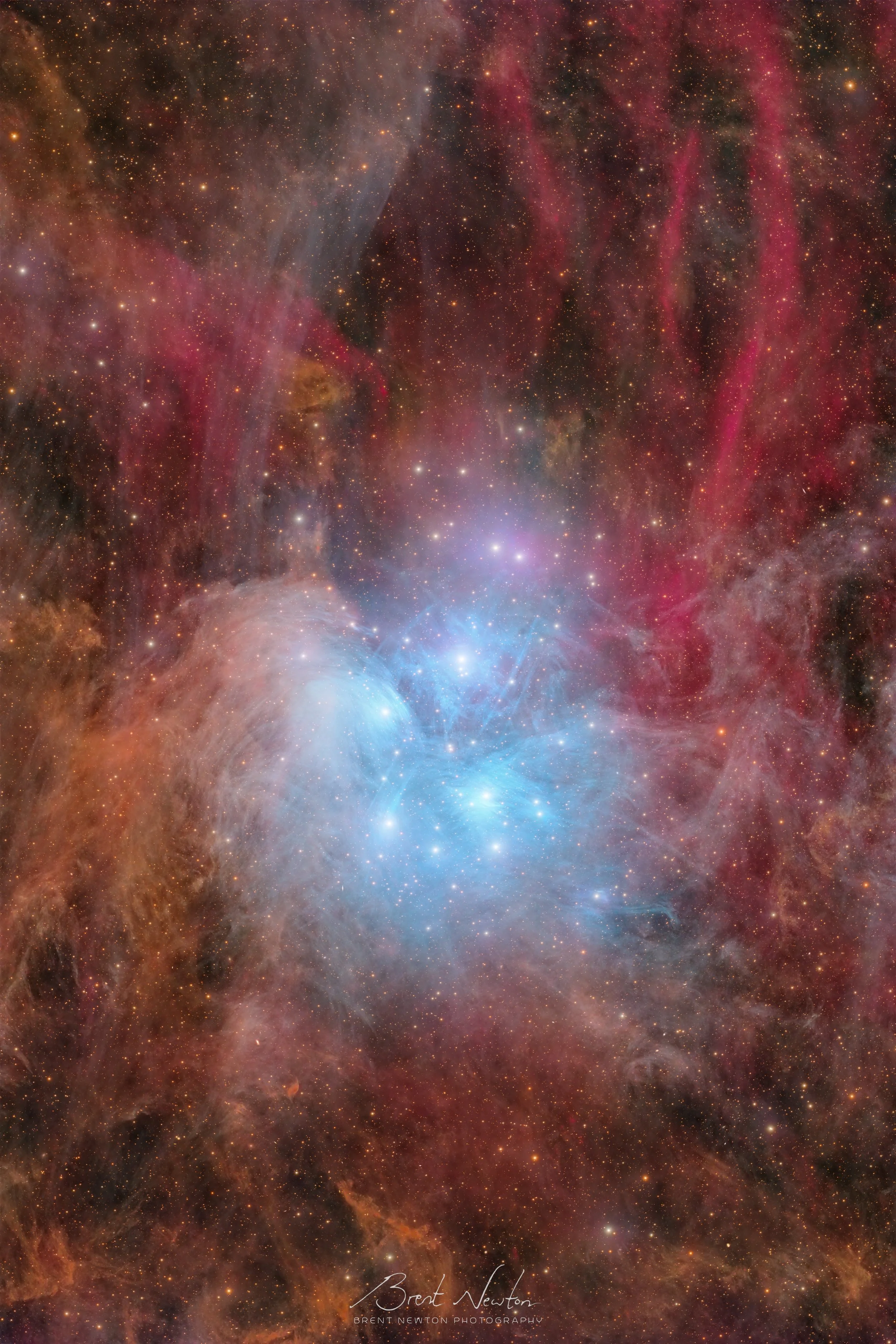
Fallen Angel
Selected as Astrobin’s Image of the Day on April 13th, 2026
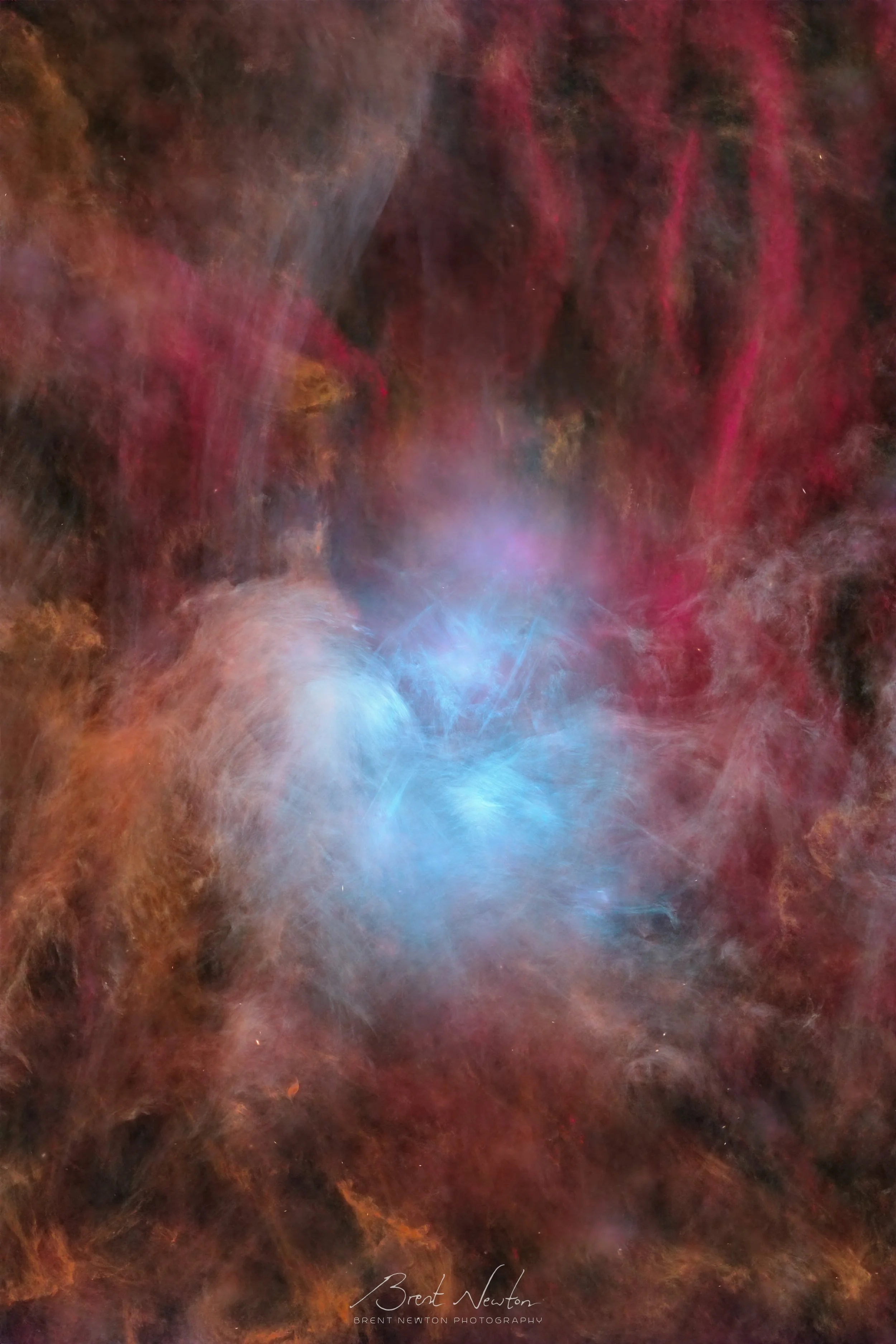
Starless
Image Details:
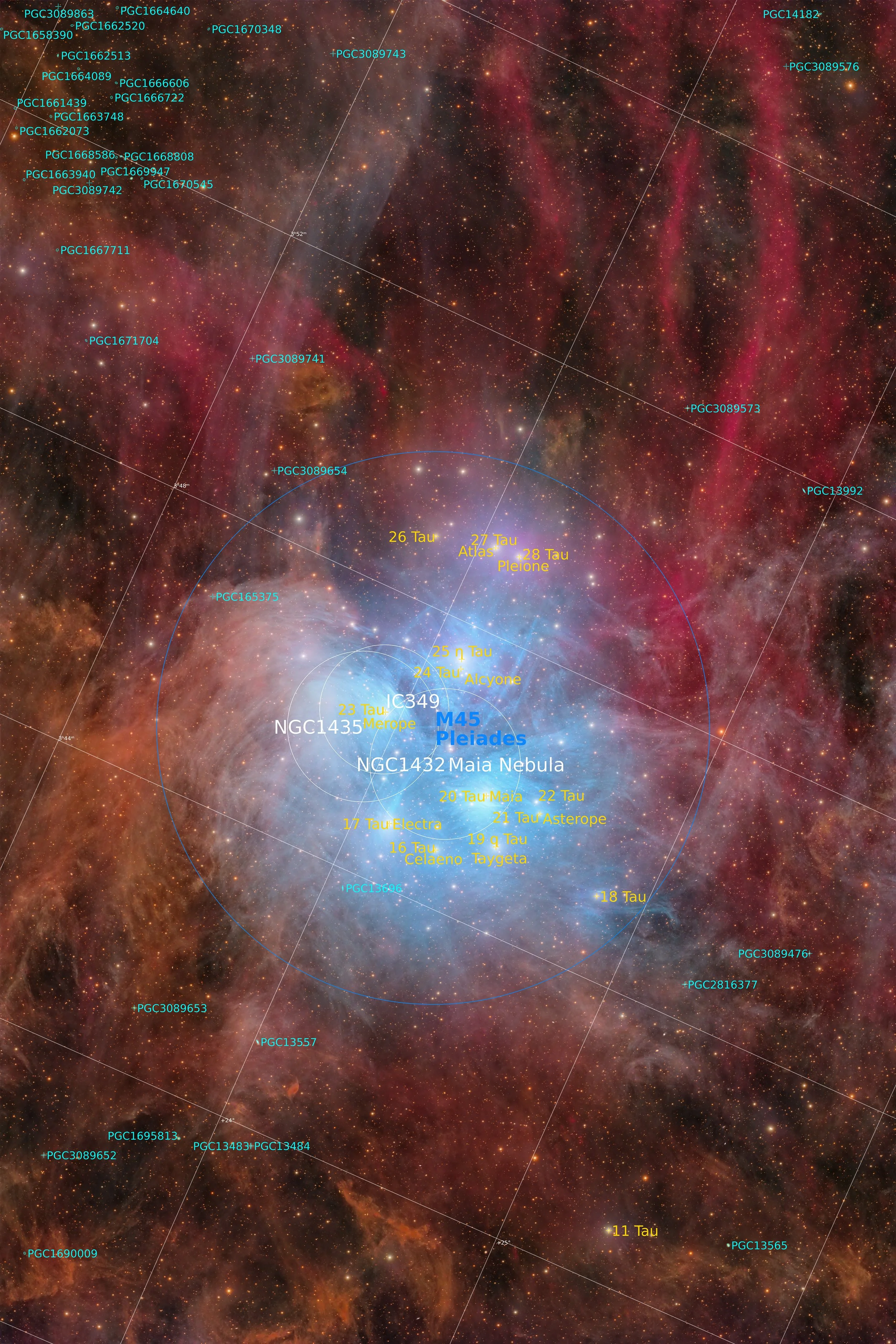
The Pleiades (Messier 45) are a small but bright cluster of stars located just under 450 light years away in the constellation of Taurus. Due to their proximity to the equatorial band of our sky, this makes them easily visible from both hemispheres, and as such they have been noted by many cultures throughout history across the world. Ancient Astronomy was the foundation of the earliest calendars, and in response many peoples wrote their culture into the stars, with this small cluster taking on a variety of names which I covered in my previous shot of this target in 2019.
One of my goals in targeting this area was to capture the faint ribbons of H-Alpha which are visible in magenta across the top half of the shot and more faintly as a diffuse glow near the bottom. Much more prominent across this shot (though less so in previous attempts) is broadband dust, most notably the bright reflection nebula illuminated by the Pleiades which appears either sky-blue (due to the same reason our sky is blue; Rayleigh Scattering) or a more bleached grey further out from their stellar light sources. Two of the more prominent blue reflection nebulae are named separately as the Maia and Merope nebulae. Dark nebula, or clouds of dust which predominantly block starlight instead of reflecting it, appear as a dark orange or brown, most prominently on the left and lower halves of the shot. Taurus is home to the imaginatively named Taurus Molecular Cloud Complex and dust like this appears all over the area of sky.
Equipment:
TS Optics 86mm Petzval (459mm Focal Length F/5.4)
ZWO ASI6200MM-P, Antlia LRGB, 3nm HA)
AstroPhysics Mach2GTO Mount
Autoguiding: Orion 50mm Guidescope + ZWO ASI174MM
Exposures:
Luminance: 206 x 300” (Total: 17h 10m)
Red, Green, Blue: 152, 147, 148x 300” (Total: 37h 15m)
Hydrogen-A 3nm: 201x 600” (Total: 33h 30m)
Misc Details:
Capture Software: N.I.N.A. (capture), PHD2 (guiding)
Processing Software: PixInsight
Taken from: Starfront Observatories, TX, Bortle 1
Capture Dates: 16-17, 21, 24-25 November, 1, 9-11, 20-21, 23, 26-27 December, 2025, 3, 6, 8-10, 13-18, 21 January, 2026 (26 total nights)