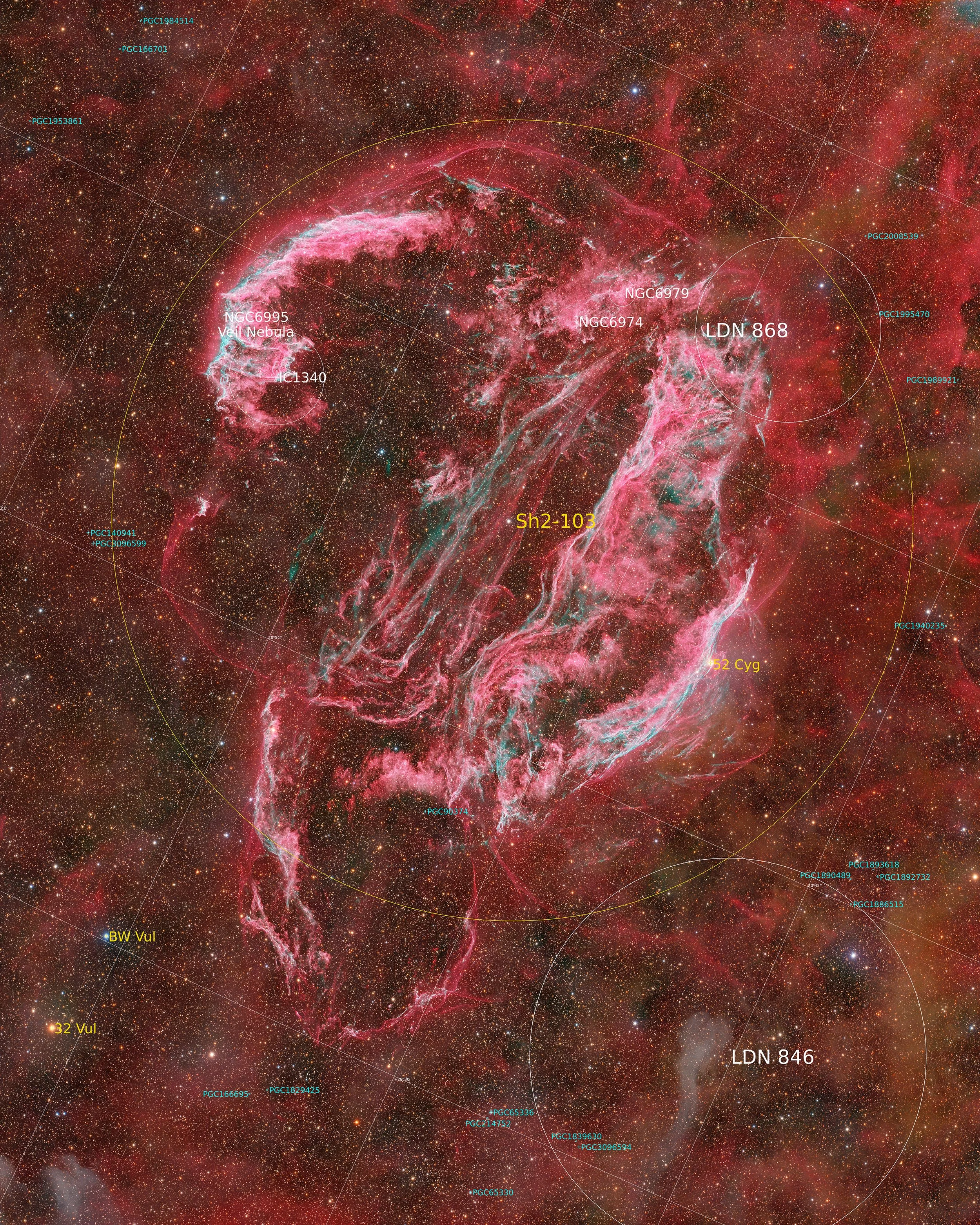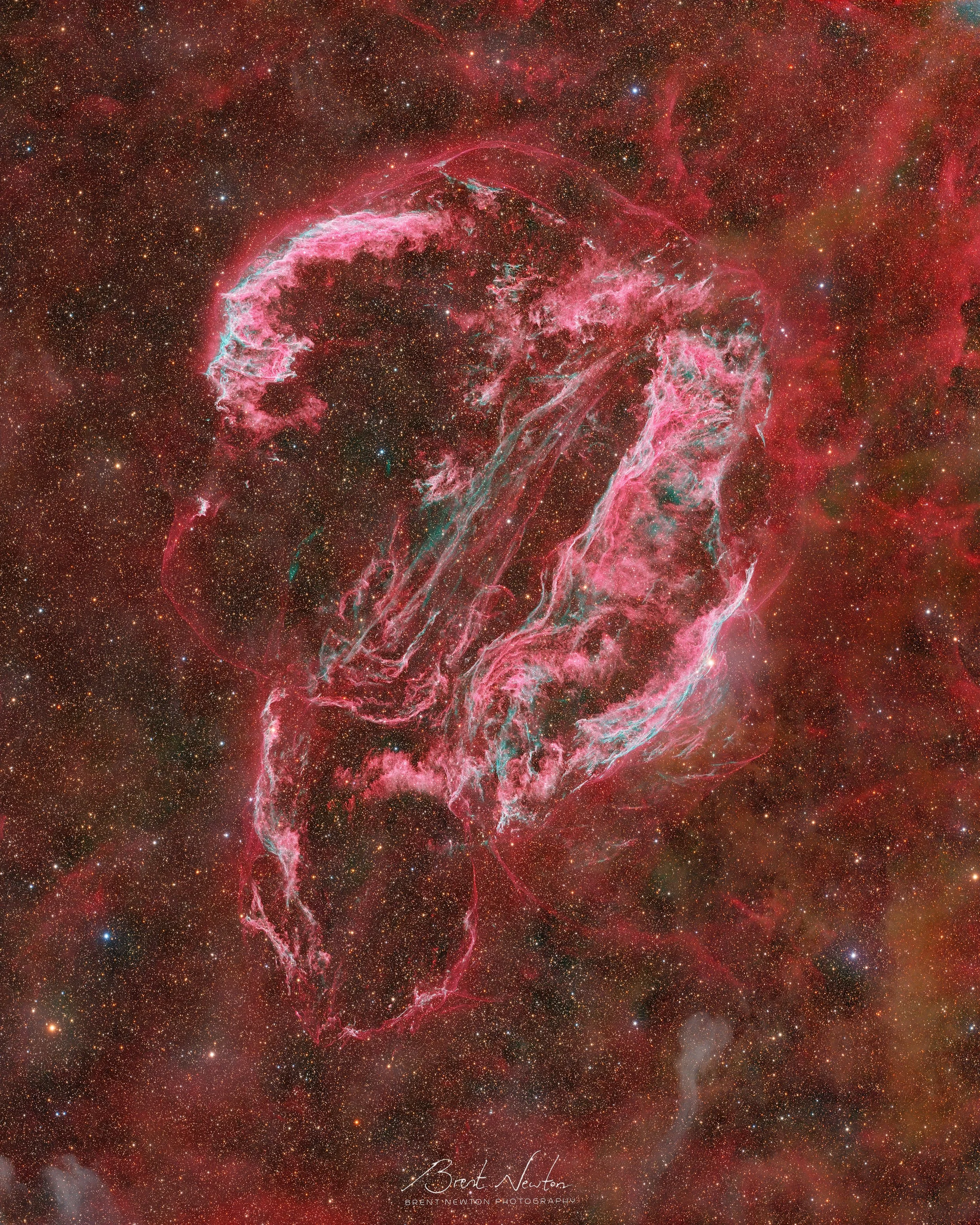
The Cygnus Veil
Selected as Astrobin’s Image of the Day on April 5th, 2026
Object Details:
This nebula is a supernova remnant (SNR), or the result of a star of approximately 8 times the mass of our own Sun (or more) encountering a natural conclusion of physics and chemistry. Stars are massive collections of Hydrogen and Helium, and the massive gravitational pressure in their cores causes these elements to fuse into heavier elements, generating energy which keeps the star from collapsing further under gravity. This continues towards heavier and heavier elements over time, with more massive stars reaching further into the Periodic Table at accelerating rates near the end of their ‘life.’ Sufficiently heavy stars will eventually reach the point of creating Iron (Fe). The problem is that while the Hydrogen to Helium fusion produces energy, each successive fusion produces less, with Iron produced through fusion being the net-zero point. This loss of sustained energy causes the star to cool and immediately collapse at upwards of a quarter of the speed of light. However, the scenario of 8+ solar masses of matter suddenly occupying the same space is itself not a stable scenario, and this causes a degenerate ignition, vaporizing the star in a colossal rebound explosion called a Supernova. The nebula seen here is the result of that explosion and is a shell of incandescent matter spreading outwards at roughly 50km/s. The details found in such objects are often very striking - space is full of high energy events like this, but usually nebula appear much more ghostly and abstract than the sharp details found on the bowshock of a a stellar detonation.
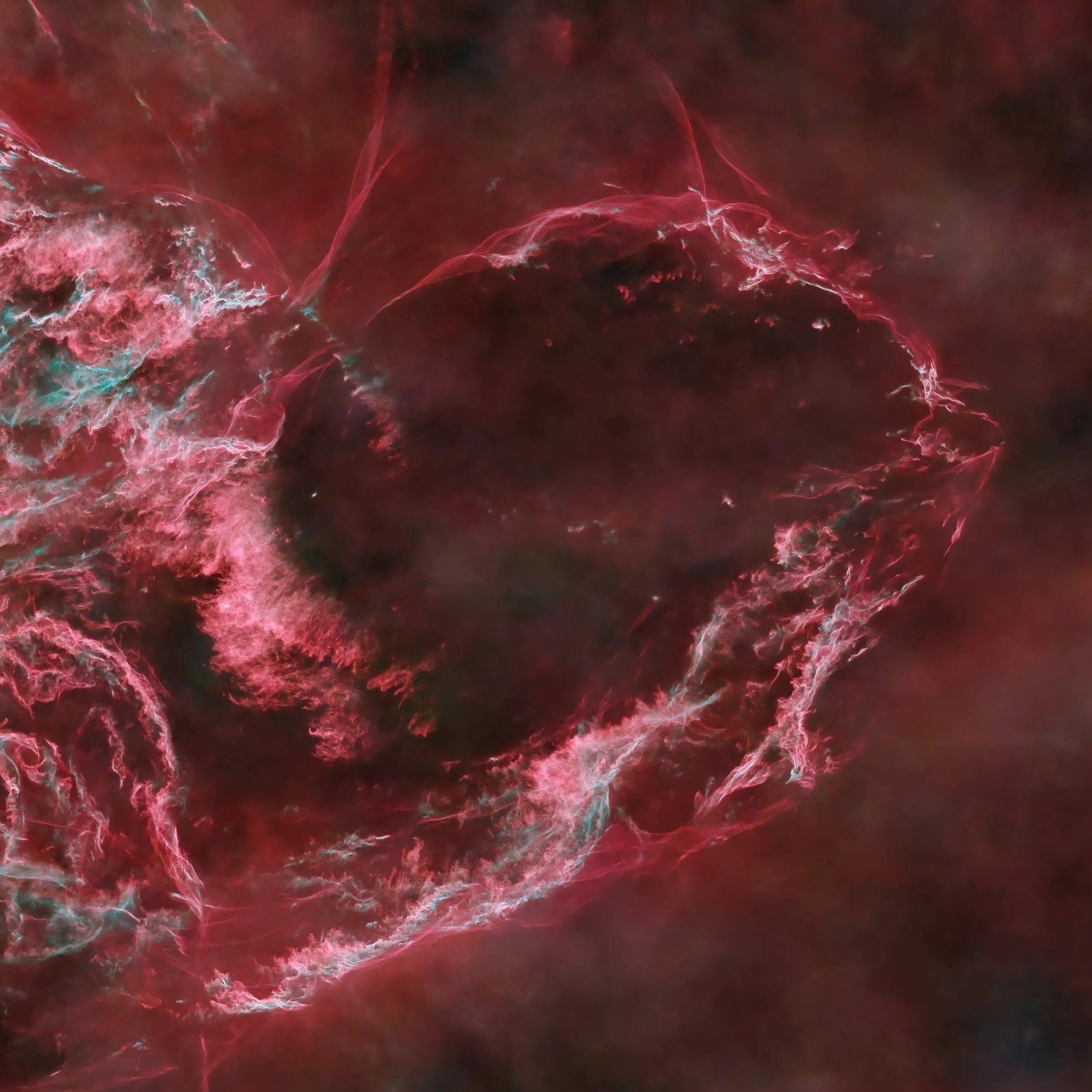
These amount of light produced by these events is comparable to the light output of entire galaxies hosting hundreds of billions of stars. From Earth a supernova would appear like a new star in the sky, sometimes rivaling the Full Moon in luminosity (including being visible during the daytime) and lasting several weeks before fading back into darkness. Supernova are also commonly observed in other galaxies, appearing as a new bright spot, then also fading back down into invisibility over the same timeframe. Throughout recorded history supernova visible to the naked eye from Earth were either written down by ancient Astronomers (typically described as a new star) or depicted in cave drawings (though these interpretations are not always certain). Historians can also use this as a calendar marker by matching a known Supernova Remnant Nebula with any historical texts which noted the appearance of a new star in a relevant area of the sky (such as the Crab Nebula, which was noted by Chinese Astronomers as having appeared as a new star in July of 1054).
This particular SNR is found off to one side of the Cygnus constellation, a large cross-shaped nebula (The Swan) which appears high overhead during Northern Hemisphere Summer. The accessible altitude of this target, and the fact that it is relatively bright (and generally very cool looking) makes it a common target for Astronomers and Astrophotographers of all skill levels. As an aside, visually this nebula (particularly the Eastern section in the Upper Left) appears like a dim ghostly grey cluster of tendrils, but long exposure enables color capture. Some visual Astronomers also report that holding an Oxygen filter up to the naked eye from a dark location reveals this nebula as a small semi-circle in the sky. The event creating this object happened some 5-10 thousand years and was roughly 2,000 light years away, with the stellar material now forming this shell of about 110 light years in diameter.
Capture Details:
This nebula also represents the largest effort I have put into any single shot as it accounts for over 350 hours of capture, with about 326 hours used in the final stack (and 323GB of RAW data). Though that total could be split in half as this was shot as a 2-panel mosaic (or Panorama). My goal in shooting this object was to form a deep True Color shot as, while this nebula is commonly shot by hundreds (if not thousands) of Astrophotographers every year, it is often edited in false color by mapping filtered Hydrogen emission light to Red and Oxygen to Green and Blue - sometimes with only a couple hours of broadband color light included for True Color stars. Personally I think this leaves a lot of interesting background detail left uncaptured and I was disappointed to not find any truly deep shots of this region online (or at least on Astrobin), which is why I spent much more time on Luminance (the entire spectrum of visible light) and RGB (color captured as separate Red, Green, and Blue shot) exposures than is typically used. This gave me much greater contrast to work with and the color filters were able to capture much more broadband light which would be largely ignored by the emission line filters. This is seen in the orange-brown broadband dust across the right side of the shot, the ethereal blue-grey reflection areas found in a 2 spots across the bottom of the shot, and across much of the left side of the image as much dimmer grey.
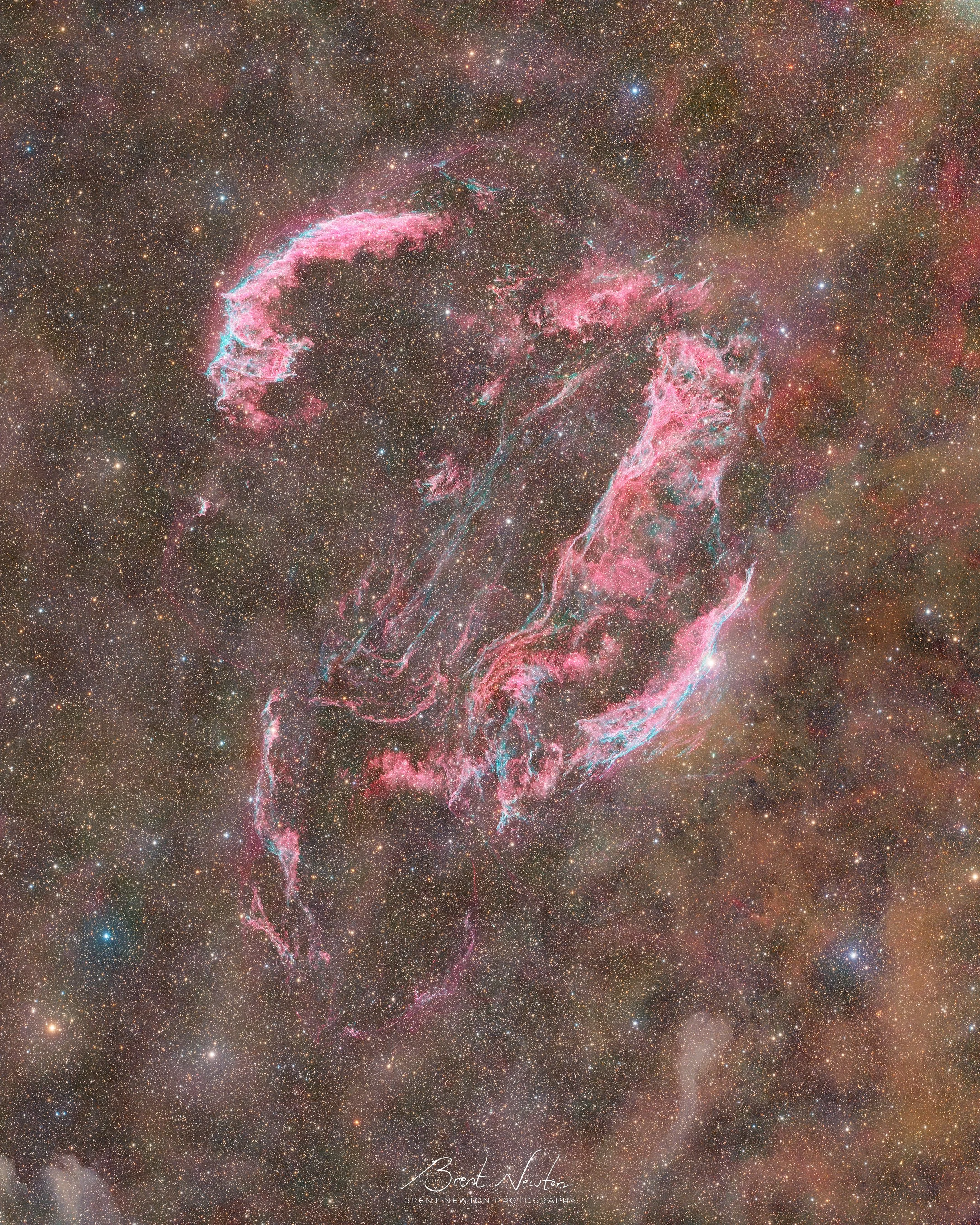
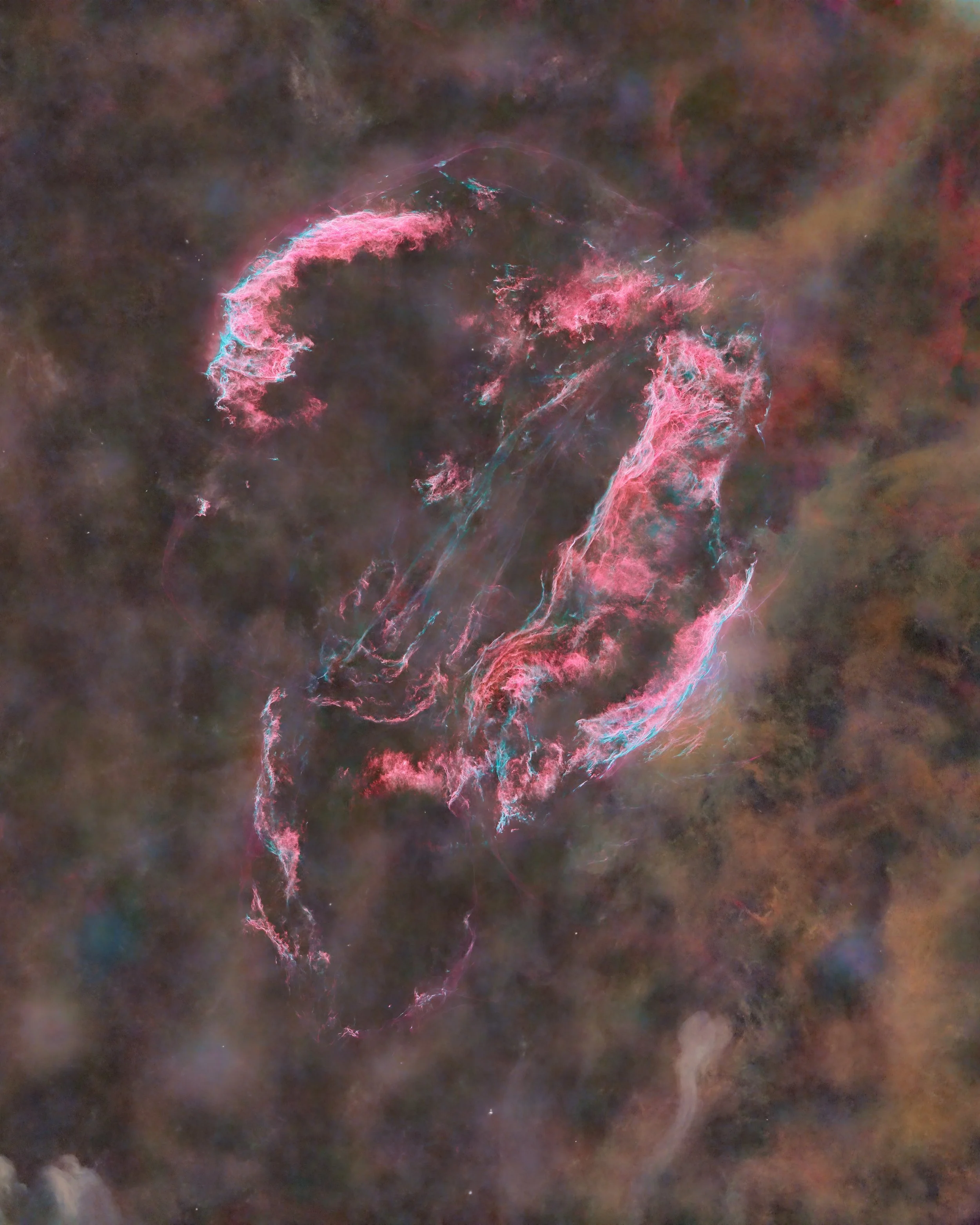
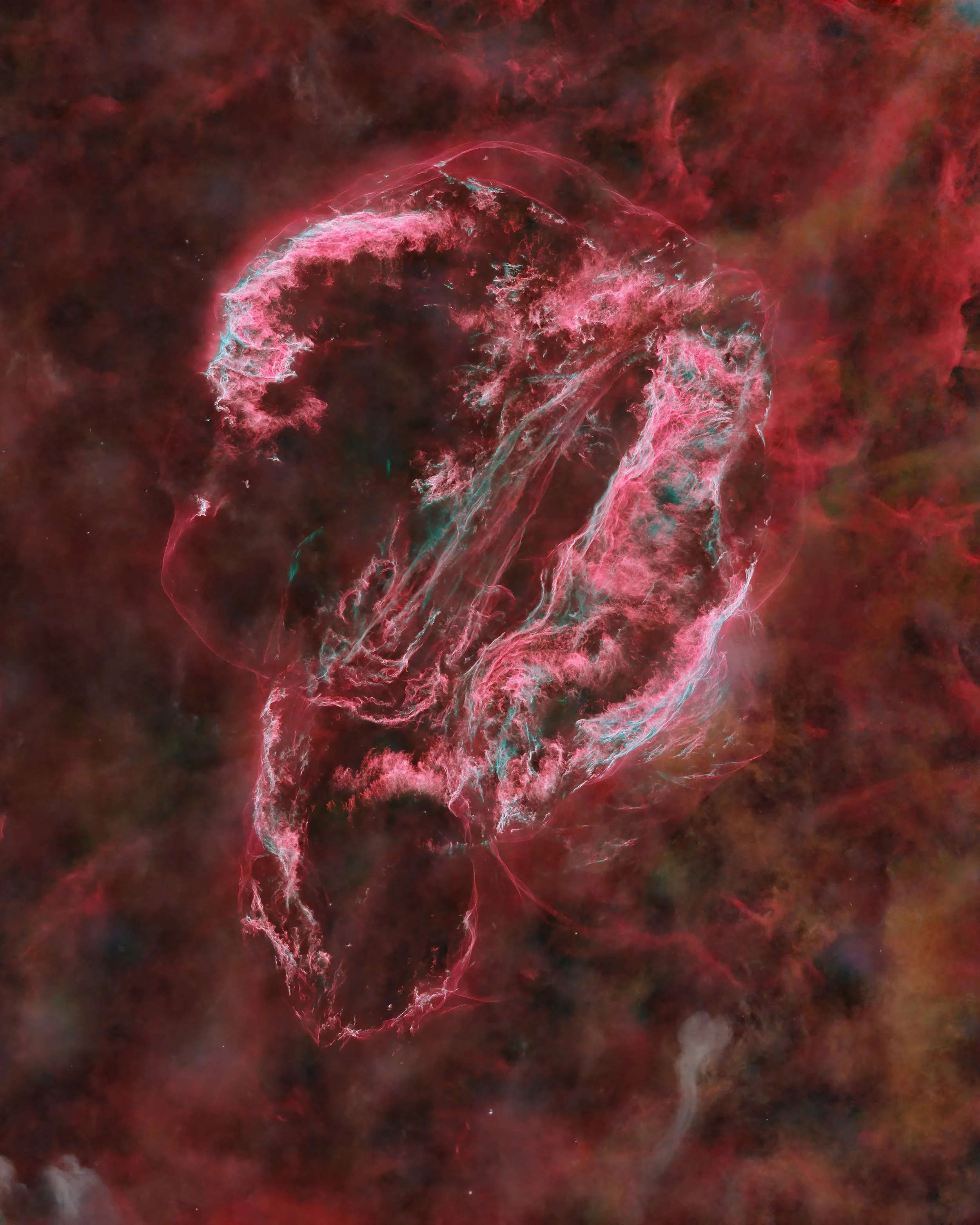
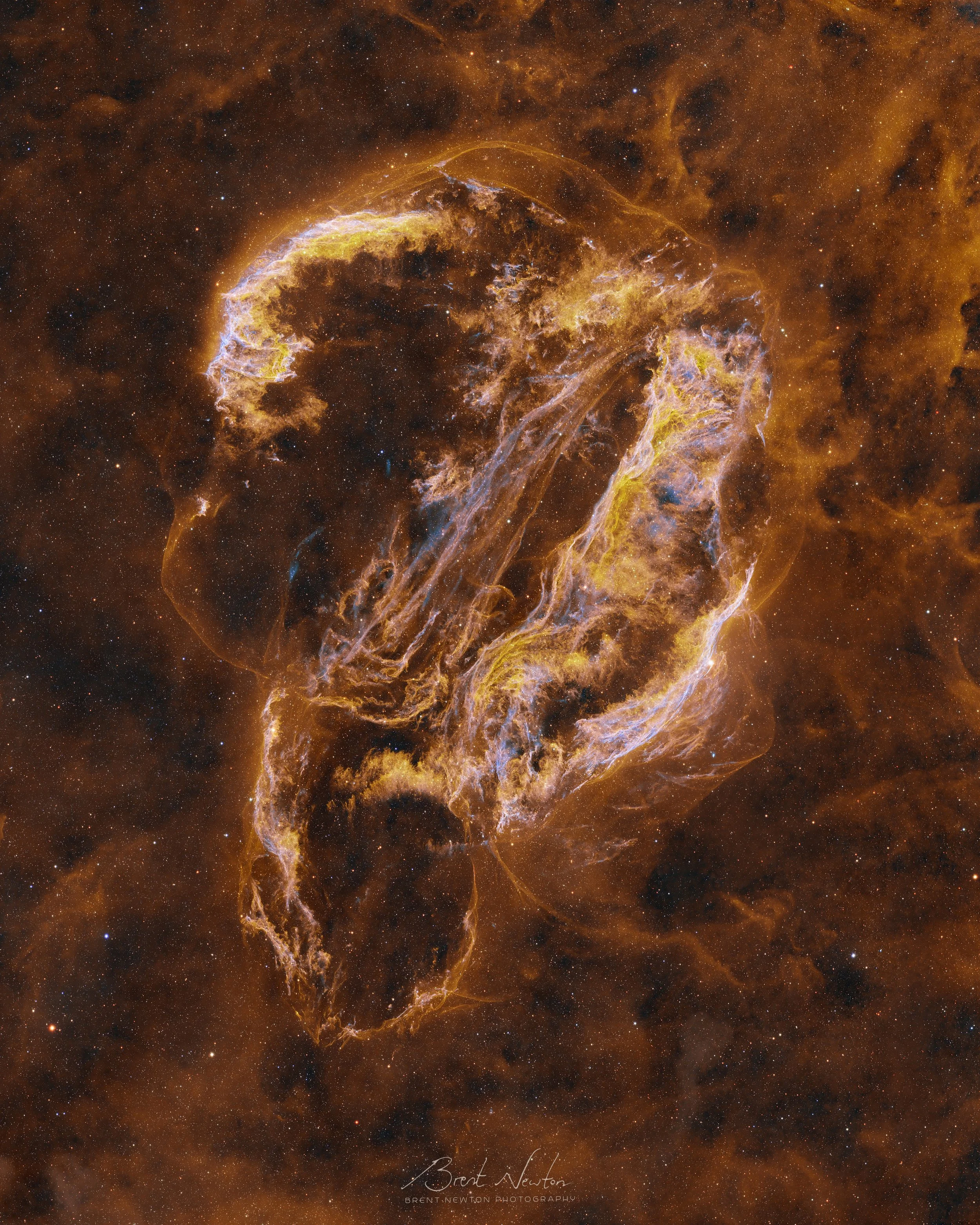
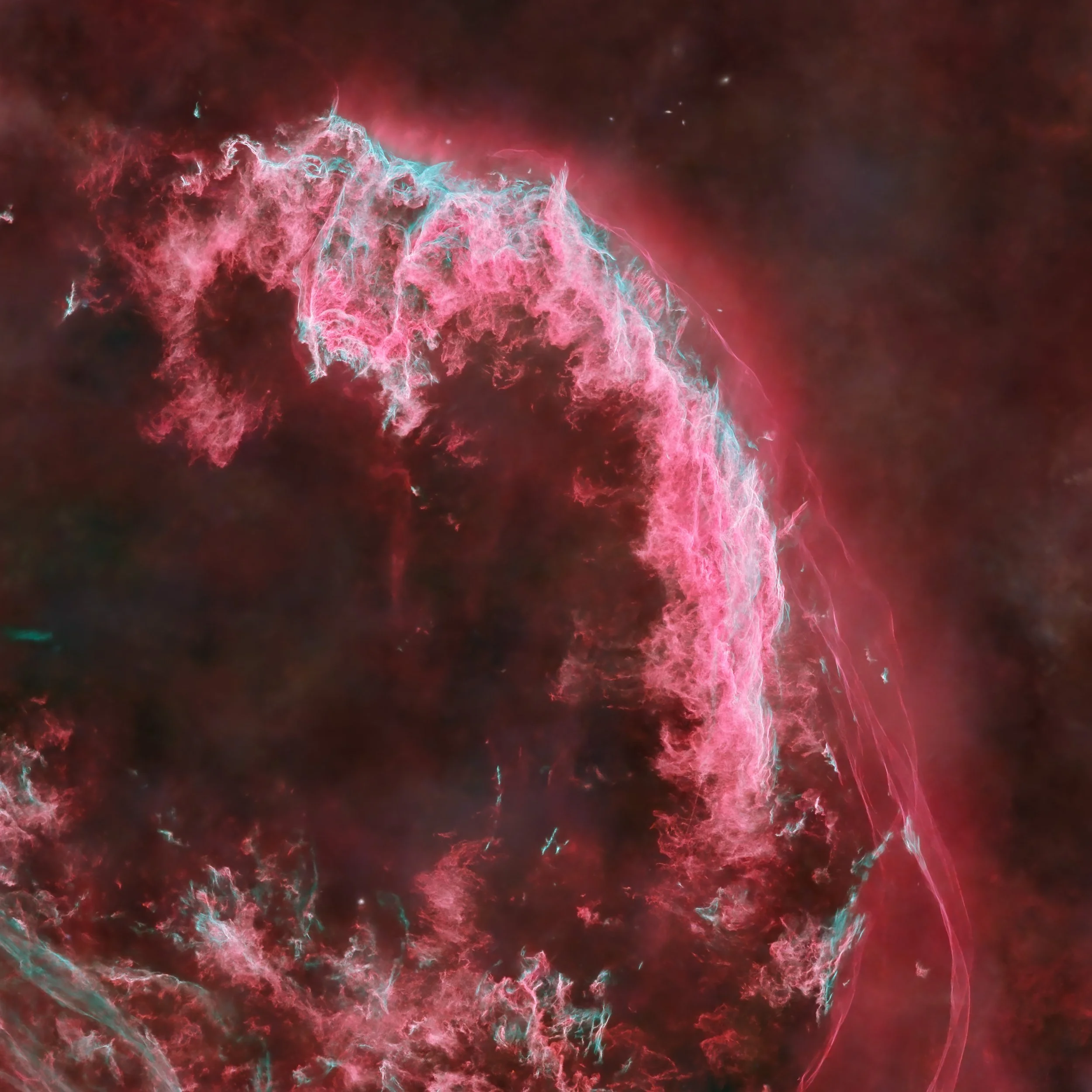
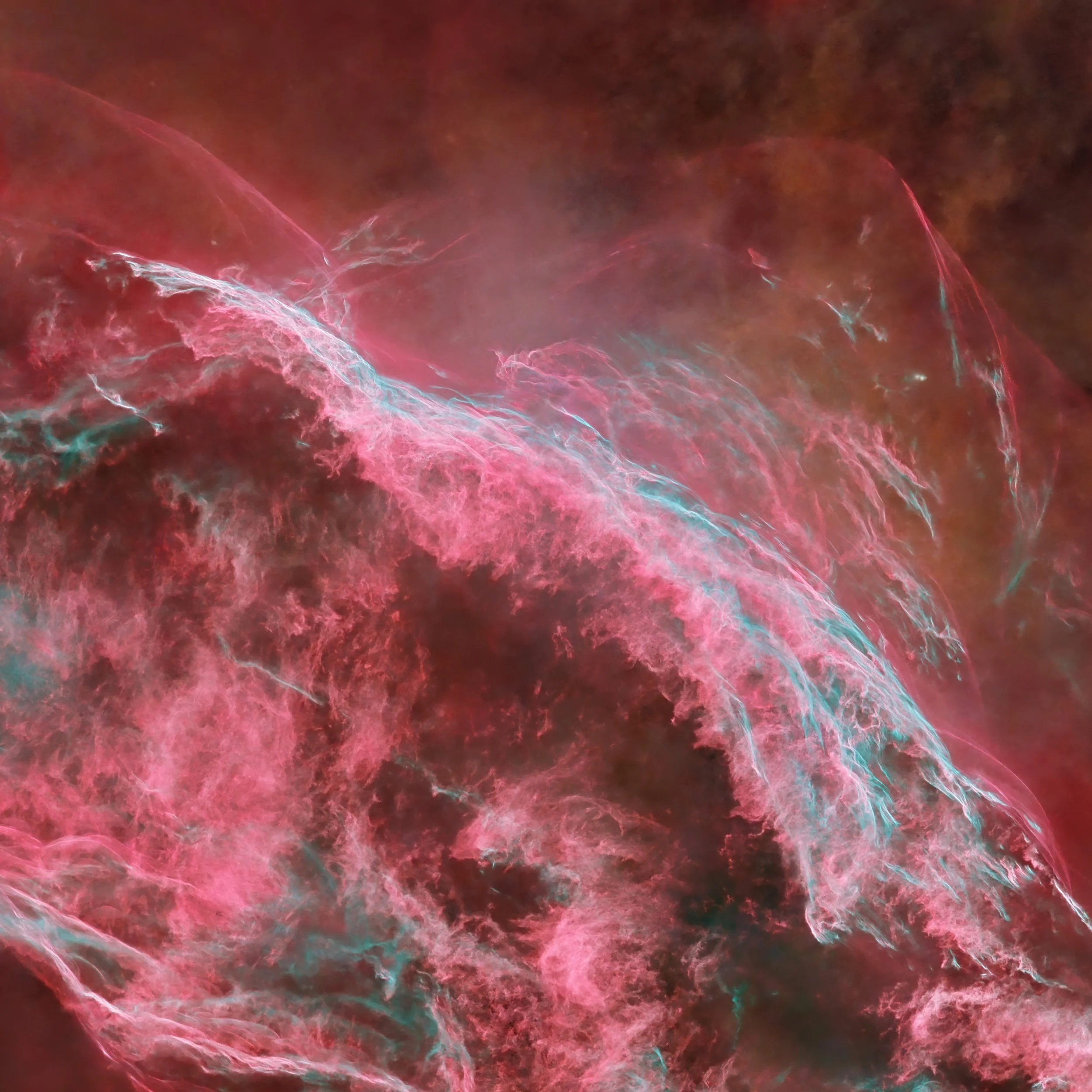
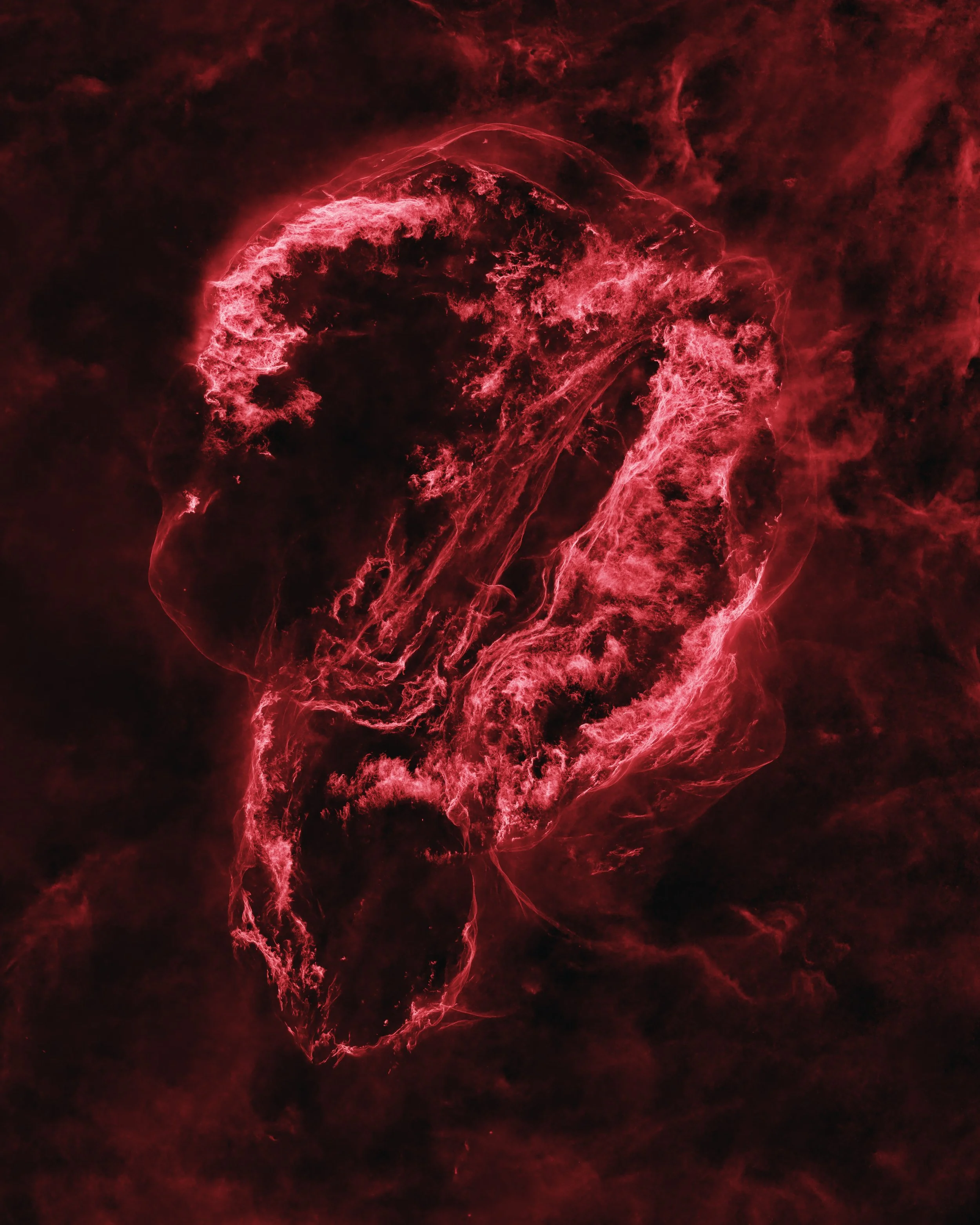
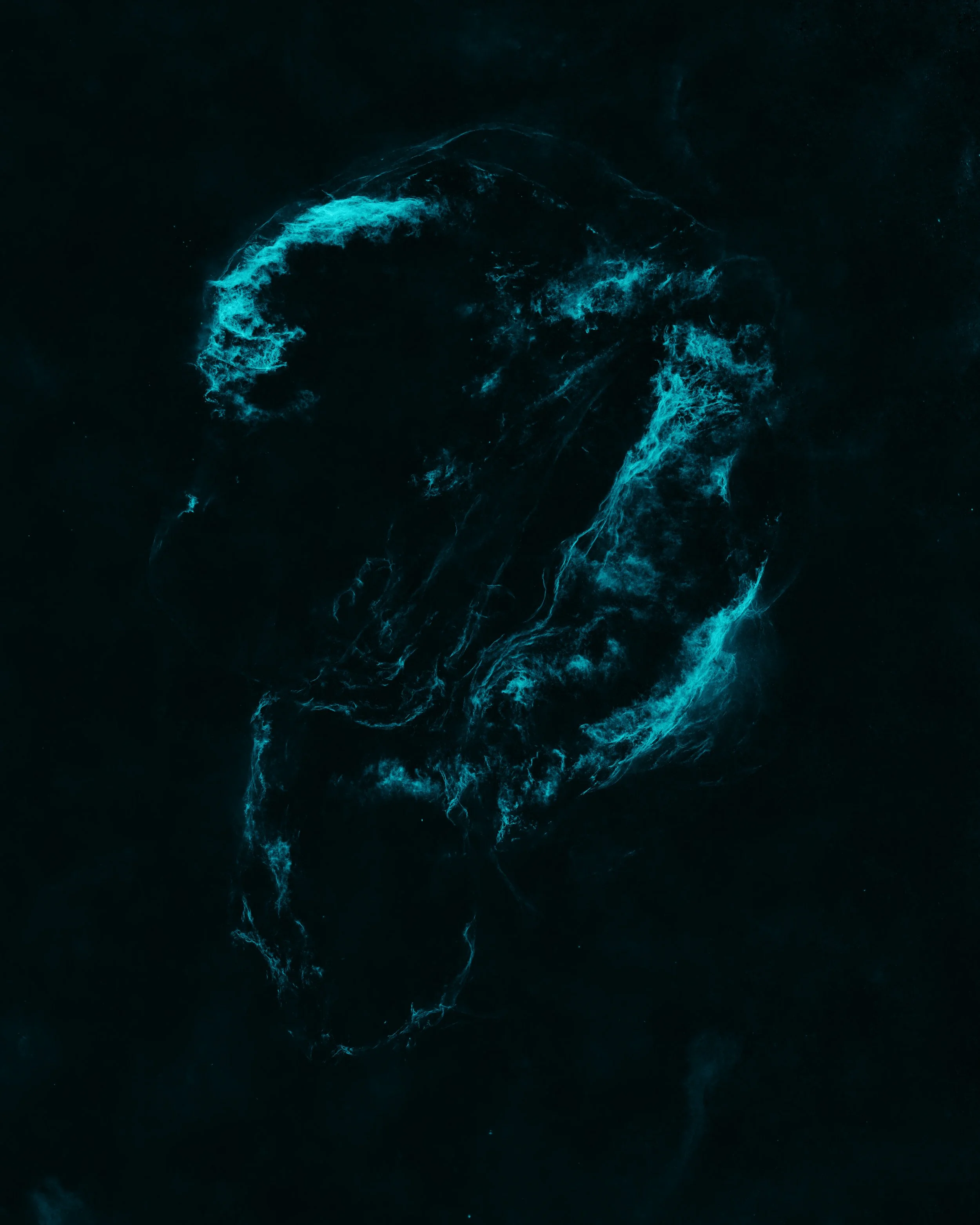
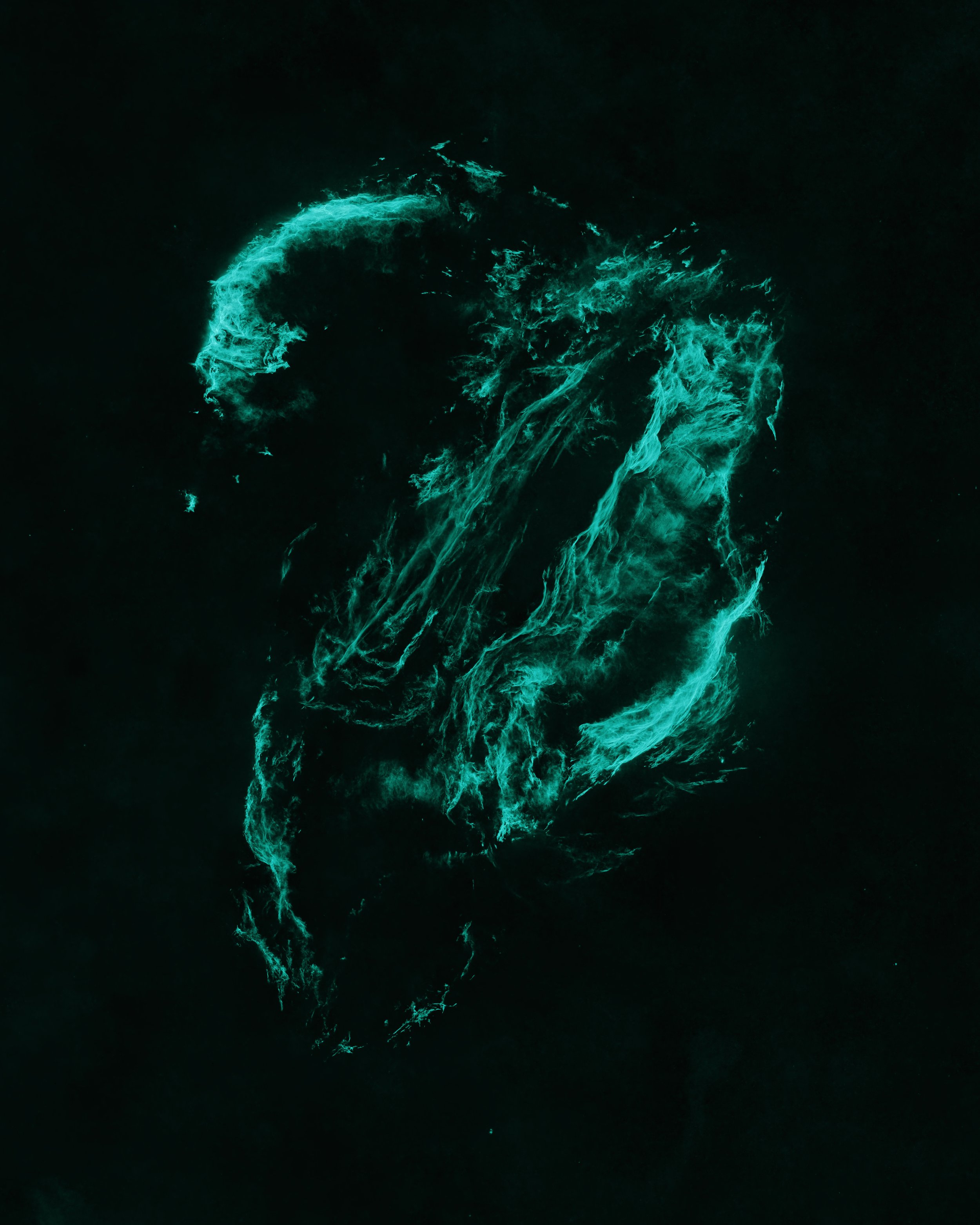
My Hydrogen-Beta filter also makes an appearance, itself a rarely used accessory in Astrophotography, in order to accurately capture the blue wavelength emitted by Hydrogen (which is mostly targeted for its more common α/Alpha band, a deep red). By using both Hydrogen A and β I am able to form a much more color-accurate shot. The typical method used by many imagers (myself included) is to only capture the A band and then simply map it primarily to Red and in a lesser amount to Blue, reflecting the natural ratio. I would say this is a guess at best, but even my own method misses even lesser bandwidths produced by Hydrogen such as the more violet Hydrogen-Γ/Gamma and other bandwidths deeper into the Balmer series that are eventually lost into the Ultraviolet spectrum. As with many pursuits in amateur (and even professional) Astronomy, however, I consider this method ‘close enough.’ This is why the brighter (higher energy) nebula has a more pink tone while the background is more red - Hydrogen-B is “harder” to produce and is thus less common. Fof or illustrative purposes, I include 3 colorized shots of the monochrome narrowband shots captured to boost the color images seen above.
HA colored Red, Oiii colored a Teal/Cyan, and HB colored Blue. In reality both Oiii and even the HB would appear much more green, but they were colored here to best match how they appeared in the RGB shot (lab conditions showing a true spectral wavelength are of course often different from reality, where interference can occur from, in this case, many lightyears of dust being in the way)
Equipment:
TS Optics 86mm Petzval (486mm Focal Length F/5.6)
ZWO ASI6200MM-P, Antlia LRGB, 3nm HA and Oiii , Baader 8.5nm Hβ)
AstroPhysics Mach2GTO Mount
Autoguiding: Orion 50mm Guidescope + ZWO ASI174MM
Exposures:
Luminance: 401 x 300” (Total: 33h 25m)
Red, Green, Blue: 367, 363, 376 x 300” (Total: 92h 10m)
Hydrogen-A 3nm: 422 x 600” (Total: 70h 20m)
Hydrogen-β 8.5nm: 356 x 600” (Total: 59h 20m)
Oxygen-III 3nm: 427 x 600” (Total: 71h 10m)
OVERALL TOTAL: 326h 25m (~163h 12m per panel)
Misc Details:
Capture Software: N.I.N.A. (capture), PHD2 (guiding)
Processing Software: PixInsight
Taken from: Starfront Observatories, TX, Bortle 1
Capture Dates: 1-2, 8-12, 15-17, 19-21, 24-27, 30 September, 1-3, 8-15, 17-21, 26-27, 29-31 October, 1-2, 4-15, 17, 21, 24-25 November, 1-3, 7-10, 13-14, 20-21, 25 December, 2025 (74 total nights)