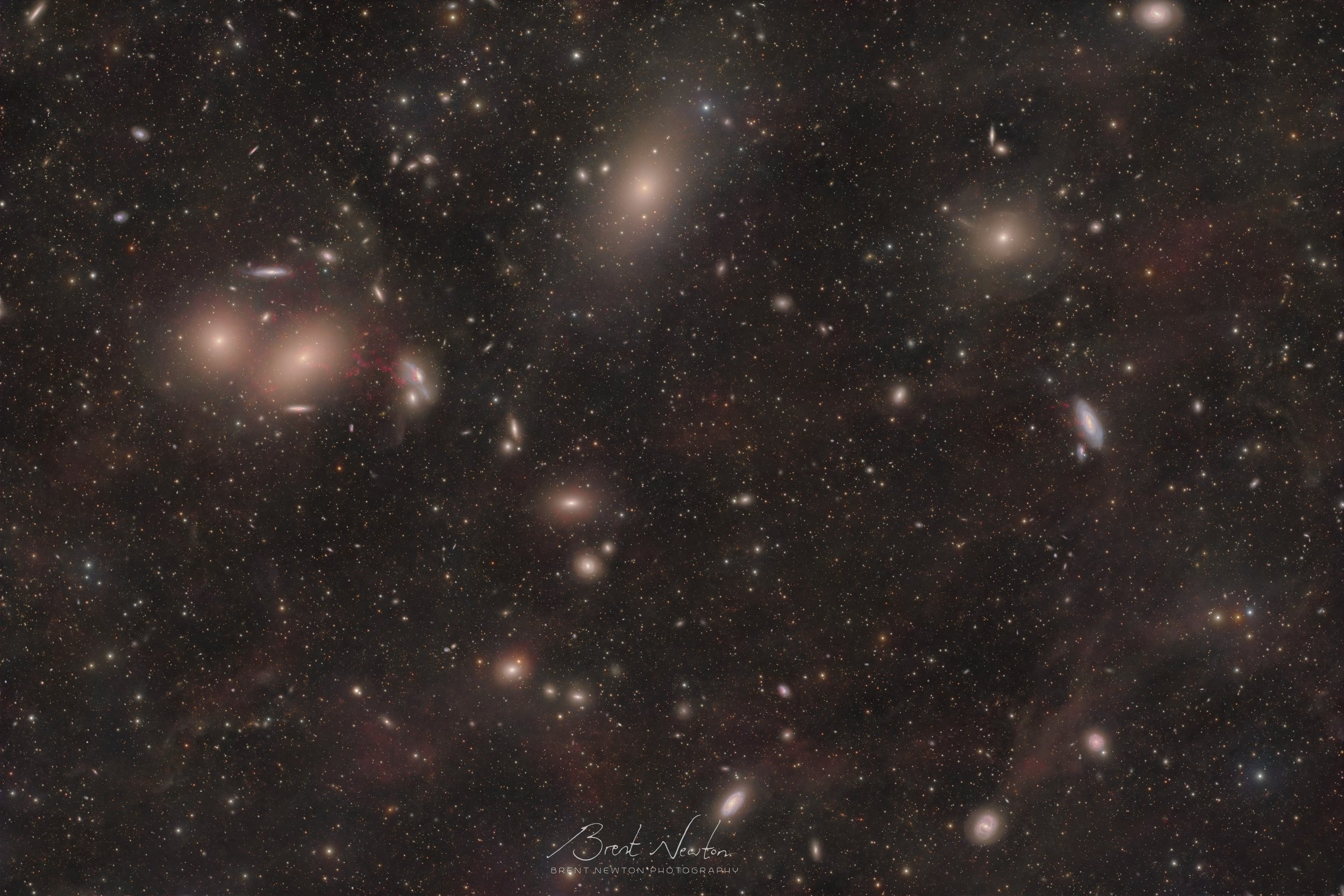
Markarian’s Chain and the Hydrogen Bridge
Image Details:
Markarian’s Chain is a section of the Virgo Cluster (the common center of gravity around which the Milky Way and our neighbors are bound, some 55 million light years away) and is a frequent target for Northern Hemisphere imagers in the Spring. Once Winter targets (and the Winter arm of the Milky Way) begin to set the sky is open to largely intergalactic space and the available targets to shoot become slim aside from small galaxies or exceedingly dim and amorphous areas of tenuous nebulosity. For most amateur imagers who operate in the 500mm focal length (or less) territory, this reduces the feasible selection of objects to shoot down to single digits - or they just wait for the Summer Milky Way to begin rising at ~2 in the morning.
This shot is the longest integration I have ever captured on this region, which I have targeted multiple times in the past. This time the dim nebulosity present throughout the Milky Way was visible (due to the telescope now living under dark skies) as brown-grey dust, with some slightly brighter spots caused by small amounts of ionized Hydrogen. One notable detail is the “Bridge” of Hα spanning M86 and the galaxy pair called The Eyes (NGC 4435, 4438). This detail has appeared more frequently in amateur photographs in recent years and is evidence of past gravitational interaction between the two galaxies (eg, they passed close to each other).
The second detail caused more of a mystery. The M87 galaxy is well known for hosting a massive black hole which was the target of the Event Horizon Telescope which generated the first image of a black hole in 2017. While these details are impossible for amateur equipment to capture, there is one small detail which is easily found in amateur images, which is a relativistic jet of charged particles being shot out from one of the black hole’s magnetic poles at over 99% light speed - in simpler terms, a death ray.
This small blue smudge is easily captured with amateur equipment and has appeared in my past photos as well, but the issue was the Hydrogen image appeared to capture two. Anything (that we know of) with one magnetic pole will have a twin, so I briefly wondered if I had captured a red-shifted pair to our more familiar blue stream of electrons, though online queries quickly returned information indicating that such a beam would redshift so hard that it would be lost into the radio spectrum at a much smaller scale of resolution than my telescope could capture. This is confirmed by professional astronomers which lose the red-shifted particle beam mere arcseconds away from the black hole.
After consulting with actual experts, discounting the possibility of internal reflections (an optical aberration) by confirming the presence of this detail in an 800-hour integration of Hydrogen, and also confirming that nothing was in the area except a few globular clusters (gravitationally bound collections of stars which orbit beyond the edges of most galaxies), one PhD kindly returned an image captured by the Spitzer telescope showing an Infrared detail in exactly the same place. Pending further information, I have to assume the Hydrogen filter, which isolates a deep red (yet still visible light) bandwidth and rejects all others outside a narrow bandwidth 3nm wide, was able to show this detail in better contrast. For context, this “second beam” does not appear in the regular color image (specifically, the Red channel), though it could be explained as being washed out by the broadband glow of the galaxy itself.
Equipment:
TS Optics 86mm Petzval (459mm Focal Length F/5.4)
ZWO ASI6200MM-P, Antlia LRGB Filters
AstroPhysics Mach2GTO Mount
Autoguiding: Orion 50mm Guidescope + ZWO ASI174MM
Exposures:
Luminance: 210 x 300” (Total: 17h 30m)
Red, Green, Blue: 146, 147, 141 x 300” (Total: 36h 10m)
Hydrogen-A 3nm: 300 x 600” (Total: 50h 0m)
Misc Details:
Capture Software: N.I.N.A. (capture), PHD2 (guiding)
Processing Software: PixInsight
Taken from: Starfront Observatories, TX, Bortle 1
Capture Dates: 11-14, 16-20, 22 March, 24 April, 2-3, 9, 11-13, 15, 18, 25, 27-28, 30 May, 1, 7-8, 10, 13, 16, 19 June, 2026 (30 total nights)
Annotation
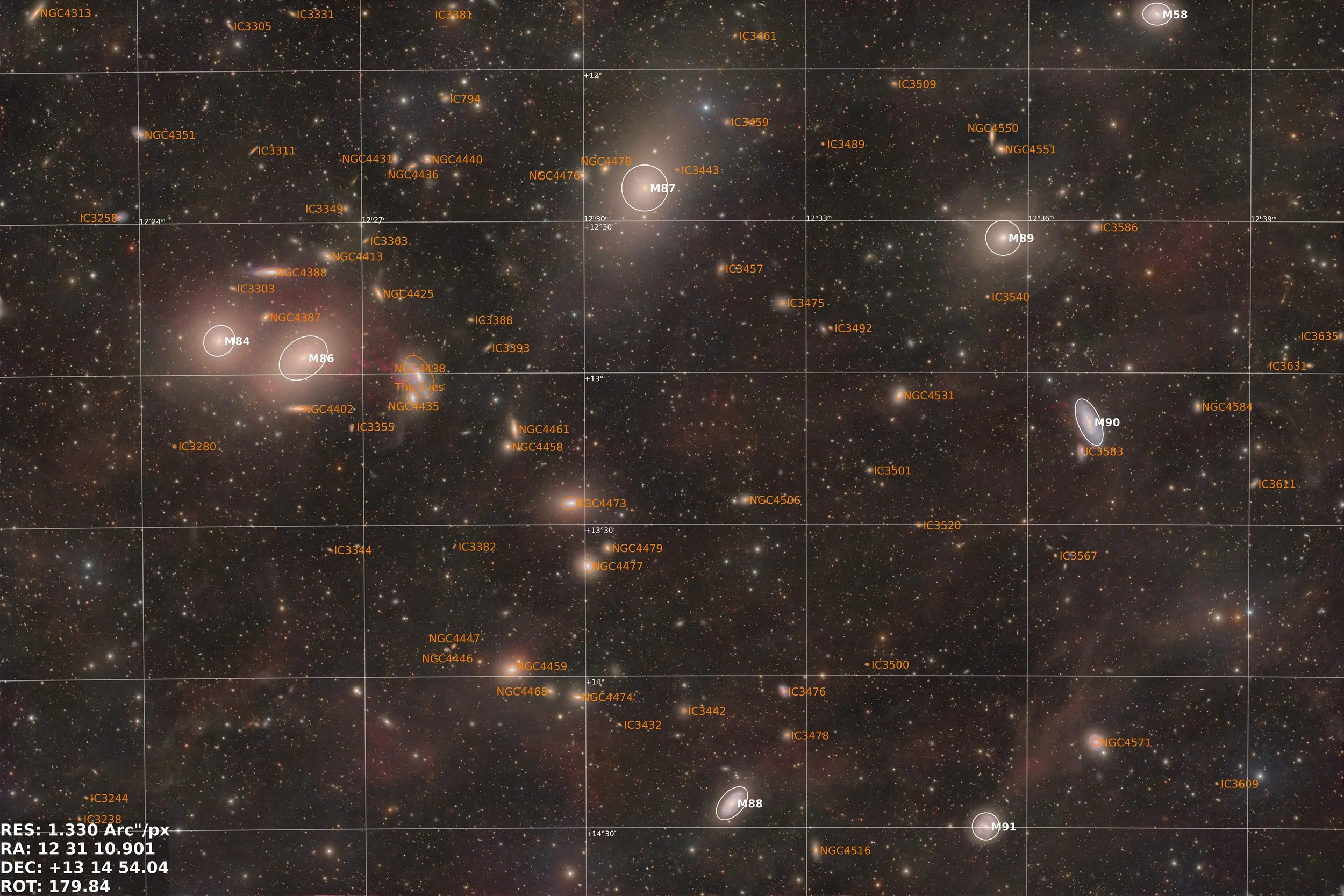
Messier and NGC
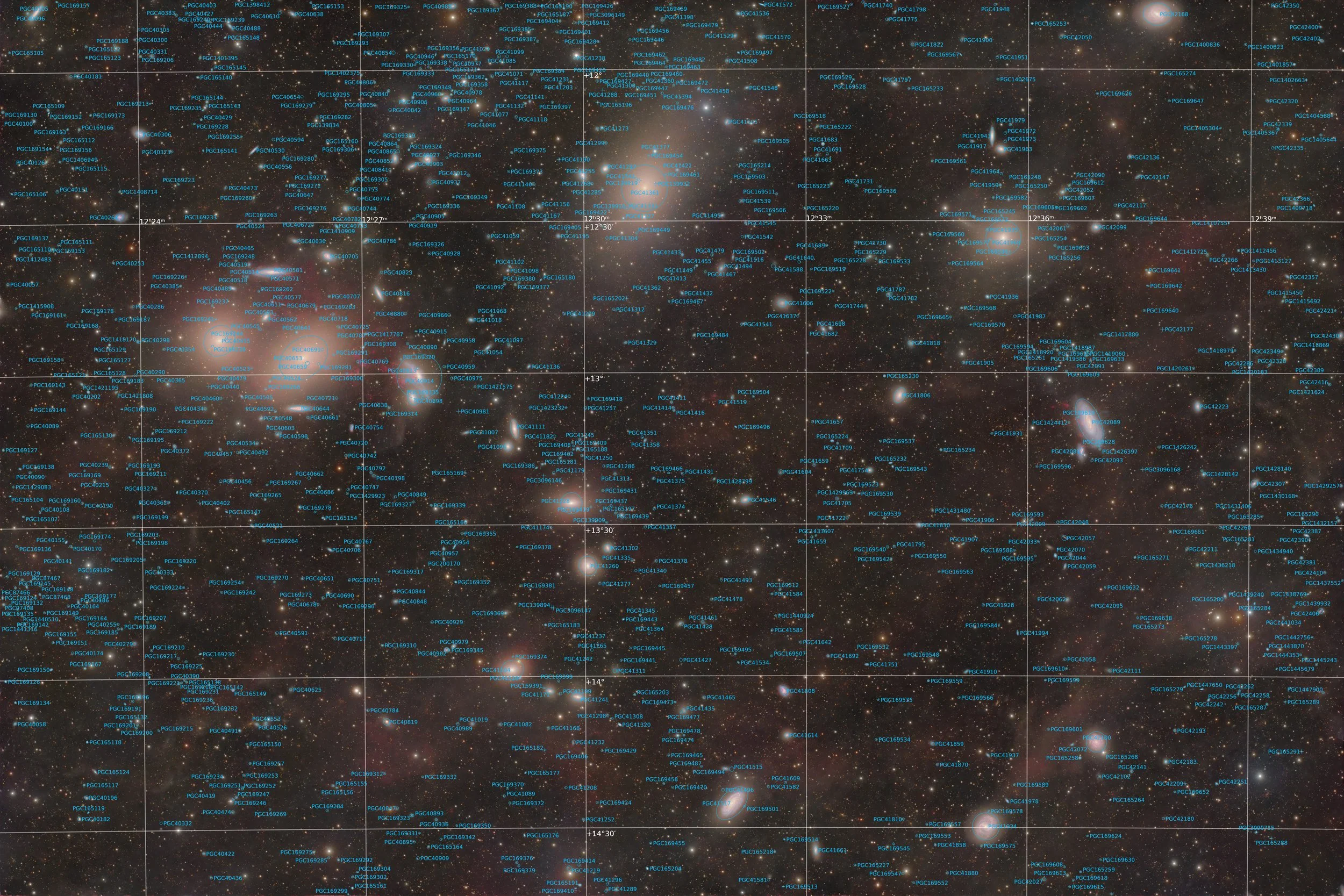
PGC Background Galaxies